Himachal Forest Encroachment Records Prompt Request for Verification and Compliance

On 15 November 2026, we submitted a representation to the Chief Secretary of Himachal Pradesh seeking verification of forest-land encroachment records and compliance with the High Court's 31 December 2026 deadline. Information obtained under the Right to Information (RTI) Act raises concerns about discrepancies in reported case numbers, unexecuted eviction orders, proposed regularisation of forest land and the absence of environmental assessments.
High Court Deadline and Discrepancies in Encroachment Records
On 22 May 2026, the Himachal Pradesh High Court recorded, on the basis of an affidavit filed by the Principal Chief Conservator of Forests (Head of Forest Force), that 5,410 cases of encroachment on forest land remained across the state. The Court directed the authorities to ensure removal of the remaining encroachments by 31 December 2026.
However, information obtained through RTI applications from June 2026 onwards presents a different picture of the cases recorded by individual forest divisions.
Our compilation of replies from twelve forest divisions identifies 7,222 recorded encroachment cases, including the following major concentrations.
- Rohru Forest Division - 2,479 cases
- Ani Forest Division - 1,788 cases
- Kullu Forest Division - 864 cases
- Chopal Forest Division - 791 cases
The compilation also identifies at least 1,232 cases involving encroachments exceeding 10 bighas, including cases above 20 bighas.
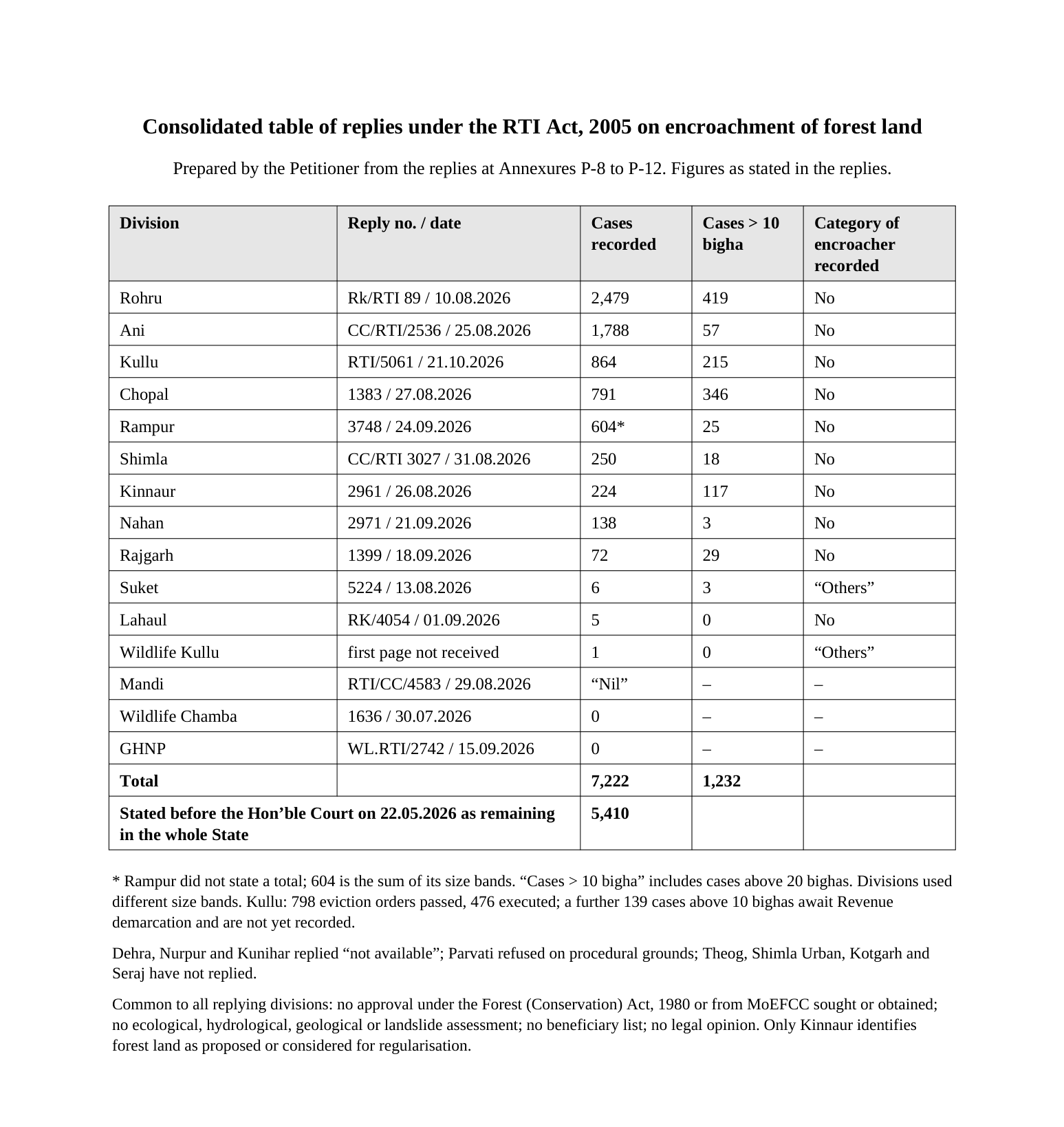
The figures require reconciliation because the High Court was informed of 5,410 remaining cases in May, while the divisional RTI replies report cases recorded at different dates. A verified, division-wise account is necessary to establish how many cases remain pending, how many eviction orders have been executed and how much forest land has actually been recovered.
The information available is also incomplete. Dehra, Nurpur and Kunihar reported that the requested information was unavailable, while replies from Theog, Shimla Urban, Kotgarh and Seraj had not been received when the representation was prepared.
Kullu Records Show a Gap Between Eviction Orders and Execution
One of the most significant findings concerns the difference between eviction orders passed and evictions actually carried out.
According to the Kullu Forest Division's Quarterly Progress Report for the quarter ending 31 March 2026, the division recorded 798 eviction orders, but only 476 had been executed.
The representation identifies 243 unexecuted orders covering approximately 41.10 hectares of forest land where no stay had been granted. The records also identify a further 139 cases involving encroachments above 10 bighas in which proceedings were awaiting demarcation by the Revenue Department.
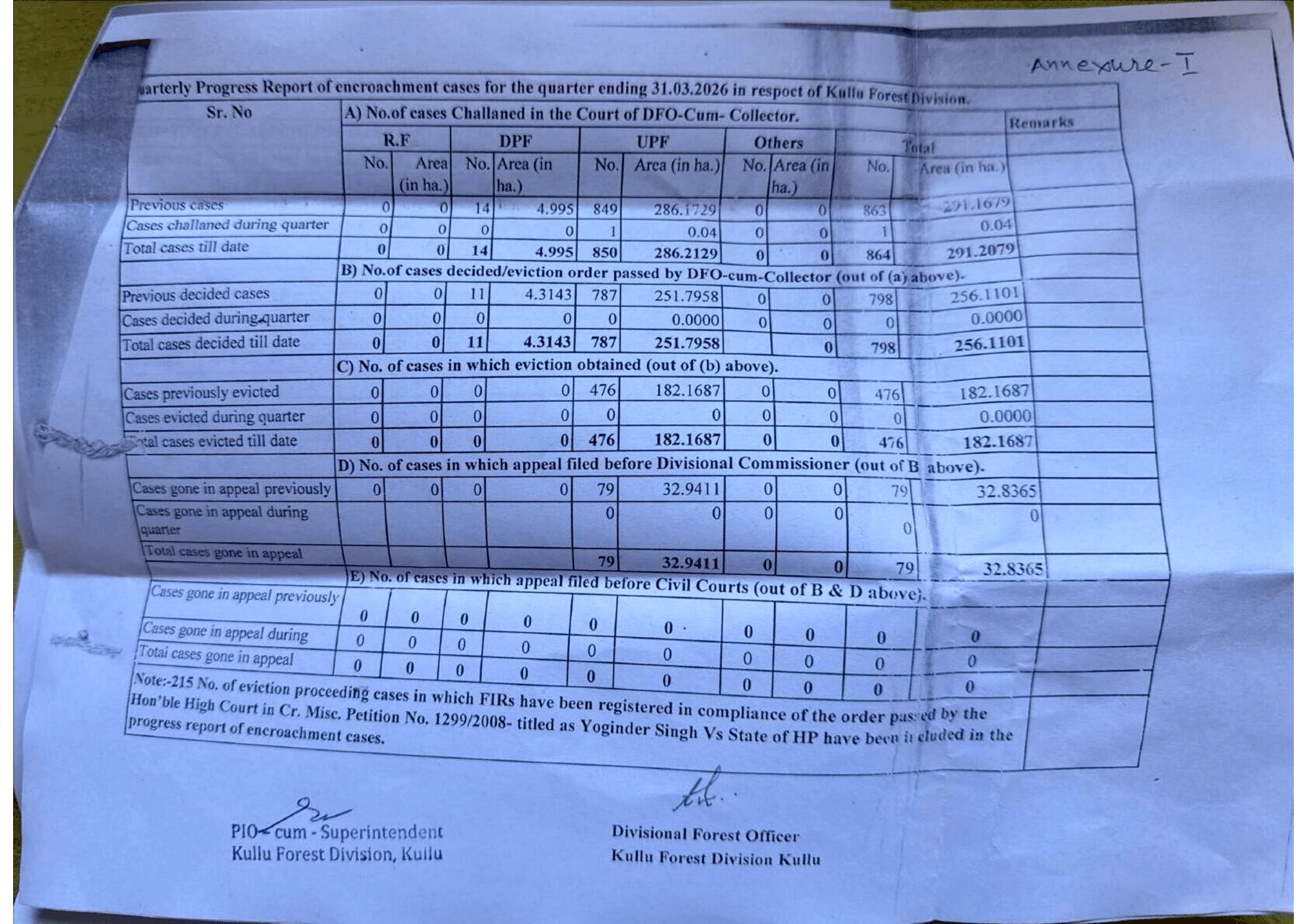
The distinction between issuing an eviction order and completing an eviction is central to assessing compliance with the High Court's direction. Orders recorded in departmental files do not, by themselves, establish that possession of encroached forest land has been restored.
Pending demarcation presents an additional administrative obstacle. Without the necessary identification and measurement of land boundaries, proceedings in the affected cases cannot advance to their required conclusion.
We have therefore requested the state government to verify the execution status of eviction orders, complete pending Revenue demarcations and ensure that orders not stayed by a competent authority are implemented before the Court's deadline.
Kinnaur RTI Reply Identifies Forest Land Considered for Regularisation
A separate concern arises from the Kinnaur Forest Division's RTI reply No. 2961 dated 26 August 2026.
The reply records 224 encroachment cases in the division, of which 117 involve areas exceeding 10 bighas. It also identifies forest land, measuring 2-30-46 ha in the reply's recorded notation, as proposed or considered for regularisation.
The land is identified through individual khasra numbers, which are official land-parcel identifiers, with a substantial portion listed under DPF Talampi.
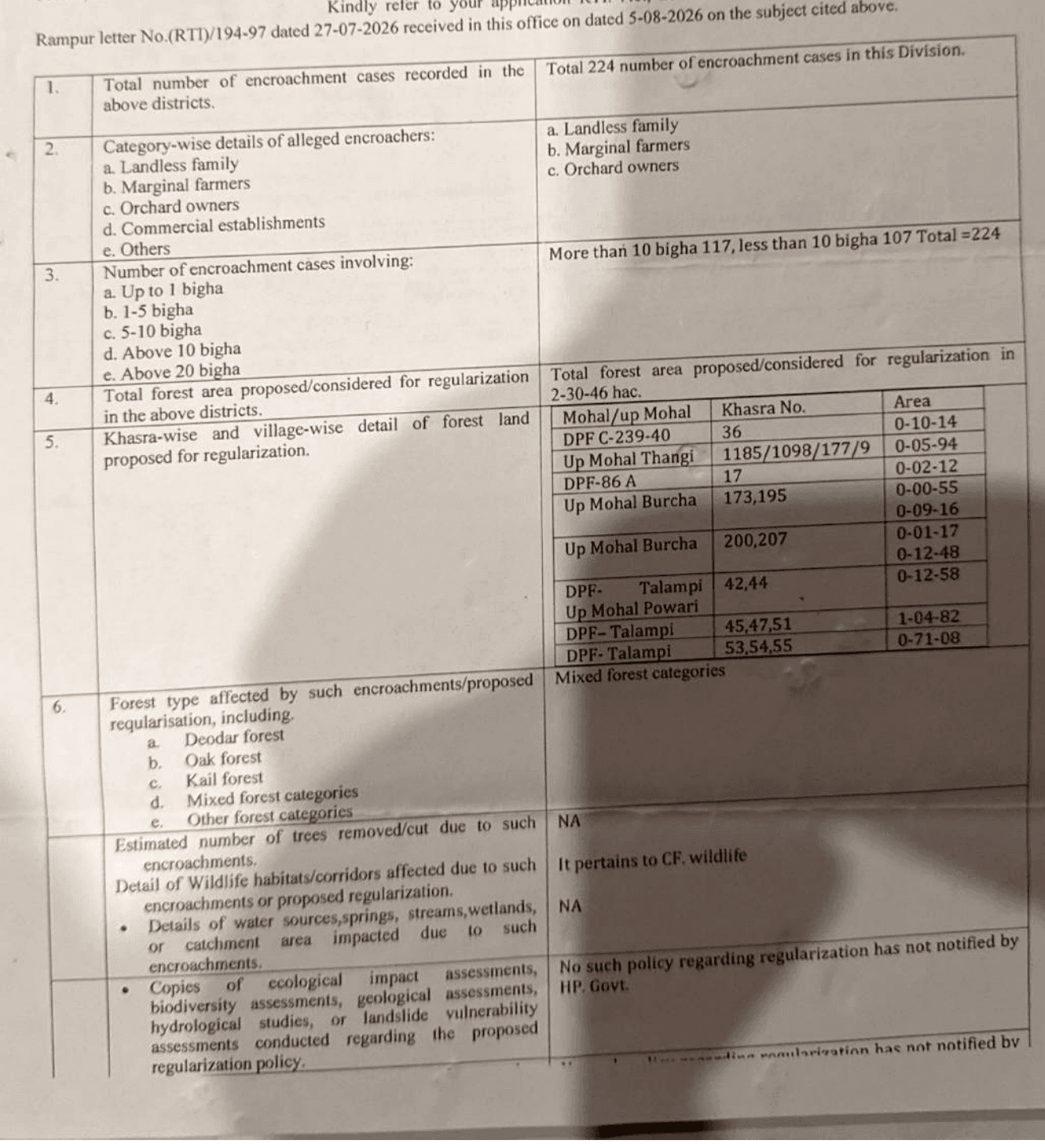
Importantly, the same reply states that no policy concerning regularisation had been notified by the Himachal Pradesh Government.
This raises a question about the basis on which forest land was being identified for possible regularisation before a notified policy was available.
The concern extends beyond land ownership. Land recorded as forest is subject to specific legal safeguards, and any proposal affecting its use must be examined in the context of those requirements.
Regularisation Policy and the Need for Transparency
The proposed regularisation policy has been the subject of public discussion since March 2026.
Reports published in early March described a government initiative to formulate a policy concerning encroachments on forest land. Subsequent reports in June stated that a Cabinet sub-committee had finalised a proposal intended to address the circumstances of small and marginal farmers.
On 6 June 2026, the Himachal Pradesh Council of Ministers was reported to have approved the Policy for Regularisation of Certain Encroachments on Government Land, 2026, intended to address the concerns of landless families and marginal farmers. The policy was also reported to have been forwarded to the Government of India for approval.
However, responses from the Department of Revenue dated 3 July and 18 August 2026 declined to disclose the policy, stating that no final decision had been taken.
In an order dated 30 July 2026, the First Appellate Authority under the RTI Act also stated that the policy had not been notified and was still under consideration. Disclosure of the policy details was consequently declined at that stage.
The distinction between the reported Cabinet approval and the department's position on finalisation and notification has left an important question unanswered.
Does the proposed 2026 regularisation policy include land officially recorded as forest?
This is particularly relevant because the policy was initially discussed in the context of forest encroachments, while the reported Cabinet decision referred more broadly to government land.
We have requested the government to make the policy's scope public. The representation also records that a second appeal concerning disclosure of the policy was pending before the State Information Commission.
Missing Forest Approvals and Environmental Assessments
The RTI findings raise concerns not only about administrative records but also about the environmental implications of encroachment and proposed regularisation.
According to the compiled replies, none of the responding forest divisions reported having sought or obtained Central Government approval under Section 2 of the Forest (Conservation) Act, 1980, for the proposed regularisation.
The replies also did not provide assessments establishing the environmental effects of the recorded encroachments.
The information gaps include the extent of tree felling, possible diversion of water sources, chemical use on encroached land and effects on wildlife habitats. Ecological, hydrological, geological and landslide-related assessments were also not made available in the responses.
The Rohru Forest Division's reply dated 25 May 2026 is particularly relevant. It recorded no permissions granted for cutting or felling forest trees for orchard expansion.
Without an assessment of the extent of ecological damage, the government cannot reliably determine the environmental costs associated with the affected forest land.
Such costs are relevant to any consideration of regularisation, particularly where forest vegetation, water resources and wildlife habitats may have been affected.
What We Have Requested from the State Government
Through the representation dated 15 November 2026, we have requested five specific actions from the Government of Himachal Pradesh.
- Verify and reconcile encroachment records. Direct the Principal Chief Conservator of Forests to compile division-wise figures covering encroachment cases, eviction orders passed, evictions executed and forest land recovered, and reconcile these with the information placed before the High Court.
- Ensure execution of pending eviction orders. Implement all eviction orders that have not been stayed by a competent authority before 31 December 2026, while directing the Revenue Department to complete outstanding land demarcations.
- Ensure compliance with forest conservation law. Prevent forest land from being listed or processed for regularisation without the prior approval of the Central Government under Section 2 of the Forest (Conservation) Act, 1980.
- Disclose the scope of the regularisation policy. Make public whether the proposed 2026 policy extends to land recorded as forest.
- Assess the environmental costs. Determine the value of trees felled, net present value and compensatory afforestation costs in every relevant case before any regularisation is considered.
These requests seek both administrative accountability and compliance with the legal safeguards applicable to forest land.
Protecting Forest Land Through Verified Records and Legal Compliance
The High Court's deadline of 31 December 2026 makes the verification of encroachment records and the execution of pending orders particularly important.
The RTI findings highlight the need to distinguish recorded cases from pending cases, eviction orders from completed evictions, and proposed regularisation from legally authorised changes in land use.
They also underline the need for transparent decision-making where forest land is concerned. Any consideration of regularisation must account for the legal status of the land and the environmental consequences of its occupation.
In our representation, we requested a response from the state government within fifteen days. We also stated that, should the concerns remain unaddressed, we may place them before the Himachal Pradesh High Court.
Our objective is to ensure that the records are verified, court directions are complied with and decisions affecting Himachal Pradesh's forests are made with full consideration of their legal and ecological implications.
Related Articles
More stories and updates worth exploring from our journey.