Shikari Devi Road Project Faces Scrutiny

Road development around the Shikari Devi Wildlife Sanctuary in Mandi district, Himachal Pradesh, has raised concerns about forest clearances, environmental damage and the cumulative impact of infrastructure expansion. Four existing or potential road corridors approaching the sensitive mountain landscape require closer examination to establish their legal status, ecological implications and long-term sustainability.
4 Road Corridors Under Examination
The Shikari Devi region is approached by several road routes, each presenting different questions concerning construction, access and environmental protection.
1. Thunag to Shikari Devi Road
The first corridor extends from Thunag through Panjut, Lambasafar and Baharar towards Chilamgad and the Shikari Devi region.
During its 73rd meeting on July 17, 2023, the Standing Committee of the National Board for Wildlife (NBWL) rejected a road proposal approaching Shikari Mata Temple from the Thunag side.
The Wildlife Institute of India had identified concerns regarding new road construction within the sanctuary, including the potential effects of rock cutting, tree felling and further disturbance to the protected landscape.
A section of the road has reportedly been constructed from the Thunag side. Its precise alignment, current construction status and relationship with the rejected proposal require verification through official records.
2. Karsog to Raigarh Road
The second corridor connects Karsog and Raigarh. Its alignment, existing condition and relationship with the wildlife sanctuary boundary need to be documented.
Establishing these details is important for understanding the wider network of roads approaching Shikari Devi and its possible environmental consequences.
3. Janjehli to Shikari Devi Road
The third corridor extends from Janjehli through Kataru, Sangalwara and Raigarh towards Shikari Devi.
Concerns have emerged regarding widening work on this route and compliance with statutory forest clearance requirements.
The NBWL Standing Committee examined a proposal involving 1.59 hectares of forest land for widening the Janjehli to Raigarh to Shikari Mata Temple road.
During its 73rd meeting, the committee returned the proposal for resubmission because of discrepancies between the proposed forest area and the actual land requirement. The committee also called for action regarding reported violations.
A subsequent regularisation process involving 4.72 hectares of forest land has been reported. However, the precise terms and legal status of this process require confirmation through the relevant government orders.
Permission to pursue regularisation must not be treated as equivalent to final statutory forest clearance.
4. Shikari Devi to Kamru Nag Corridor
The fourth corridor is a potential westward route from Shikari Devi towards Kamru Nag, connecting with the state highway towards Ner Chowk.
Preliminary examination and discussions with local residents have identified aspects of this possible connection. Its exact alignment, current development status and relationship with the sanctuary remain subjects for further investigation.
Together, these four corridors raise an important question about infrastructure planning in the region. Environmental assessment must consider not only individual roads but also their combined effects on forests, wildlife habitat, mountain slopes and visitor movement.
Field Observations Highlight Environmental Concerns
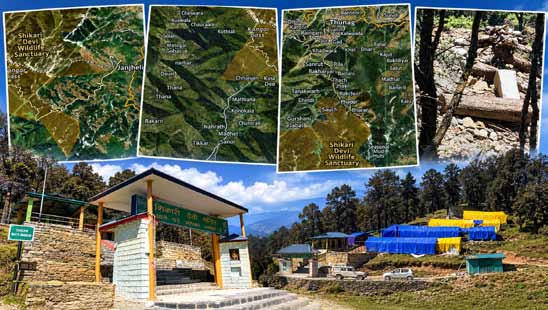
Our preliminary field documentation includes six photographs taken in the Shikari Devi region on September 23, 2026. The photographs show loose rock deposits on forested slopes, disturbed soil, fallen timber, exposed earth, grassland erosion and visitor infrastructure near the pilgrimage destination.
These visible conditions raise questions about slope stability, vegetation disturbance, drainage, debris disposal and the environmental pressures associated with increasing accessibility.
However, photographs alone cannot establish the cause or timing of the observed disturbances. They also cannot independently confirm whether the conditions resulted from road construction or any statutory violation.
A reliable assessment would require verification of photograph locations, examination of road alignment maps, comparison with historical imagery and scientific field investigations by competent authorities.
Such investigations should assess vegetation loss, tree damage, soil disturbance, drainage channels, debris disposal and potential impacts on wildlife habitat. The environmental consequences of increasing traffic, visitor activity, waste generation and infrastructure expansion must also be considered.
Forest Clearance Records Require Greater Transparency
Questions surrounding forest clearance and land diversion remain central to road development in the Shikari Devi region.
A 2025 state road inventory reportedly listed the 6.2-kilometre Raigarh to Shikari Mata road, originally named the Bhulah to Shikari Devi road, as "Complete road passed", while indicating that its clearance was absent or pending.
The associated PARIVESH reference is FP/HP/ROAD/484746/2024.
Other assessments have identified forest land requirements involving 1.59 hectares and approximately 5.10 hectares, alongside the reported 4.72-hectare regularisation process.
These figures must be examined carefully. Without establishing whether they concern the same alignment, project scope or affected land, they cannot be combined to estimate total forest damage.
The relationship between road proposals, wildlife approvals and statutory forest clearance requirements needs clarification through authenticated government records.
Transparent disclosure of the applicable permissions, project alignments, forest diversion proposals and regularisation decisions would help establish the legal and environmental status of the developments.
Tourism Growth Must Account for Ecological Costs
Tourism is an important contributor to Himachal Pradesh's economy.
According to the state's 2026-27 budget, tourism contributes approximately 7.78% of the Gross State Domestic Product, with an ambition to increase its share to 9%. The state also recorded approximately 3.11 crore tourist visits during 2025.
These figures demonstrate the economic significance of tourism and the growing importance of responsible infrastructure planning.
Road connectivity can improve access for residents, pilgrims and emergency services. However, development in environmentally sensitive mountain regions requires careful attention to the natural systems supporting those landscapes.
Inadequate drainage, slope protection, debris management and environmental monitoring can create long-term risks for forests, water systems and biodiversity. For Shikari Devi, the challenge is to improve accessibility without compromising the ecological integrity of the sanctuary and its surrounding landscape.
Independent Assessment and Environmental Accountability
An independent environmental assessment of the road corridors would help establish their present conditions, legal status and cumulative ecological impacts.
Such an assessment should address the following priorities:
- Verify the precise alignment and construction status of all four corridors.
- Examine the NBWL decisions and applicable wildlife permissions.
- Review forest clearance records and any regularisation proceedings.
- Assess vegetation loss, tree damage, slope stability and drainage conditions.
- Examine potential effects on wildlife habitats and biodiversity.
- Evaluate the combined impact of road access, tourism activity and infrastructure development.
- Identify environmental restoration requirements based on verified field evidence.
Environmental losses should not be assigned speculative monetary values without scientific evidence.
A credible assessment requires measured damage, verified tree inventories, habitat surveys and properly costed restoration plans. These measures would provide a stronger foundation for environmental accountability and informed decisions about future development.
Balancing Connectivity With Nature Conservation
The future of the Shikari Devi landscape depends on responsible decisions about infrastructure, tourism and environmental protection. Improved connectivity can serve communities and pilgrims, but development must be supported by transparent approvals, scientific assessments and appropriate environmental safeguards.
For us, protecting Shikari Devi means recognising the interdependence of its forests, mountain slopes, water systems, wildlife and surrounding communities. Greater transparency in road development decisions and a comprehensive assessment of ecological impacts would help ensure that connectivity improvements remain compatible with nature conservation.
Himachal Pradesh's tourism development should ultimately be measured not only by investment and visitor numbers, but also by its ability to preserve the natural heritage on which the state's future depends.
Related Articles
More stories and updates worth exploring from our journey.