Shikari Devi Wildlife Sanctuary: Development Without Ecological Accountability?

Shikari Devi Wildlife Sanctuary in Mandi district, Himachal Pradesh, is facing increasing pressure from road widening, motorised access, pilgrimage infrastructure and associated human activity. Our environmental investigation, including a field inspection conducted on 23 September 2026, raises important questions about forest disturbance, statutory clearances and the growing human footprint within this fragile Himalayan wildlife sanctuary.
A Sanctuary Under Pressure
Shikari Devi Wildlife Sanctuary is a legally protected wildlife habitat covering approximately 29.94 square kilometres, with a notified Eco-Sensitive Zone extending over 19.2045 square kilometres.
The sanctuary and its surrounding approaches have experienced increasing pressure from road development, motorised access, pilgrimage related infrastructure and other human activities. These developments raise concerns about their cumulative effects on the ecological integrity of this protected Himalayan landscape.
We have been investigating these developments through field inspections, satellite imagery, Right to Information (RTI) applications and official correspondence with the Forest, Wildlife and Public Works Departments.
The available evidence raises serious questions about whether development activities have proceeded ahead of the mandatory environmental and wildlife approval processes.
What Government Records Reveal
An inspection conducted by the Wildlife Department in May 2023, subsequently made available through RTI, recorded significant deficiencies concerning the Janjehli-Raigarh-Shikari Devi road.
The departmental inspection identified several important issues:
- Approximately 3 km of the Bhullah-Raigarh stretch was omitted from the forest diversion proposal, despite the sanctuary boundary reportedly beginning at Bhullah.
- Another 930 metres between Kangri Temple Gate and chainage 17/330 was omitted from the proposal.
- Road widening had already been undertaken while Forest and Wildlife clearance issues remained unresolved.
- Approximately ₹12.82 crore out of ₹14.50 crore had reportedly been spent between June 2020 and July 2022.
- Directions were issued to stop further work, including blacktopping, because the required Forest and Wildlife clearances were not in place at the time of inspection.
These findings are significant because they originate from departmental inspection records rather than solely from concerns raised by environmental organisations.
Subsequent RTI correspondence has raised further questions regarding Stage-I and Stage-II forest clearances, wildlife approvals and the status of revised proposals.
We are seeking clarification and reconciliation of the statutory approvals, expenditure records, actual road alignment and dates of construction.
Field Inspection: 23 September 2026
During our field investigation along the Janjehli-Raigarh-Shikari Devi approach, we documented visible changes to the mountain landscape, including road formation, excavated surfaces, forest disturbance and pilgrimage related infrastructure.
The inspection recorded:
- Road formation and exposed excavated surfaces on mountain slopes.
- Rock fragments, loose material and apparent construction related debris within forested terrain.
- Disturbed slopes alongside standing trees.
- Fallen tree trunks and woody material requiring verification of their origin.
- Extensive temporary pilgrim accommodation and other infrastructure near the shrine.
- Increased physical accessibility to fragile mountain habitats.
Road Widening and Pilgrimage Infrastructure
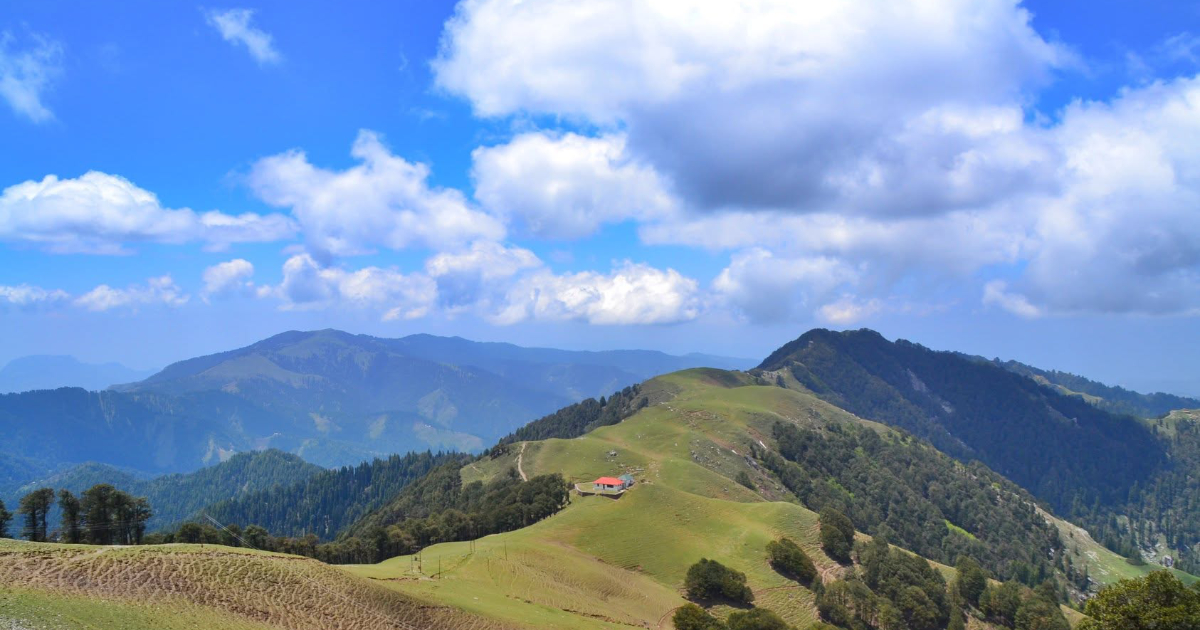
Photographs of the Shikari Devi ridge show a visible motorable road alignment crossing the grassland landscape. The images also document temporary pilgrim accommodation, tents, buildings and a widened road formation near the camp area.
The presence of these facilities illustrates the growing physical footprint of pilgrimage related activity in the sanctuary landscape.
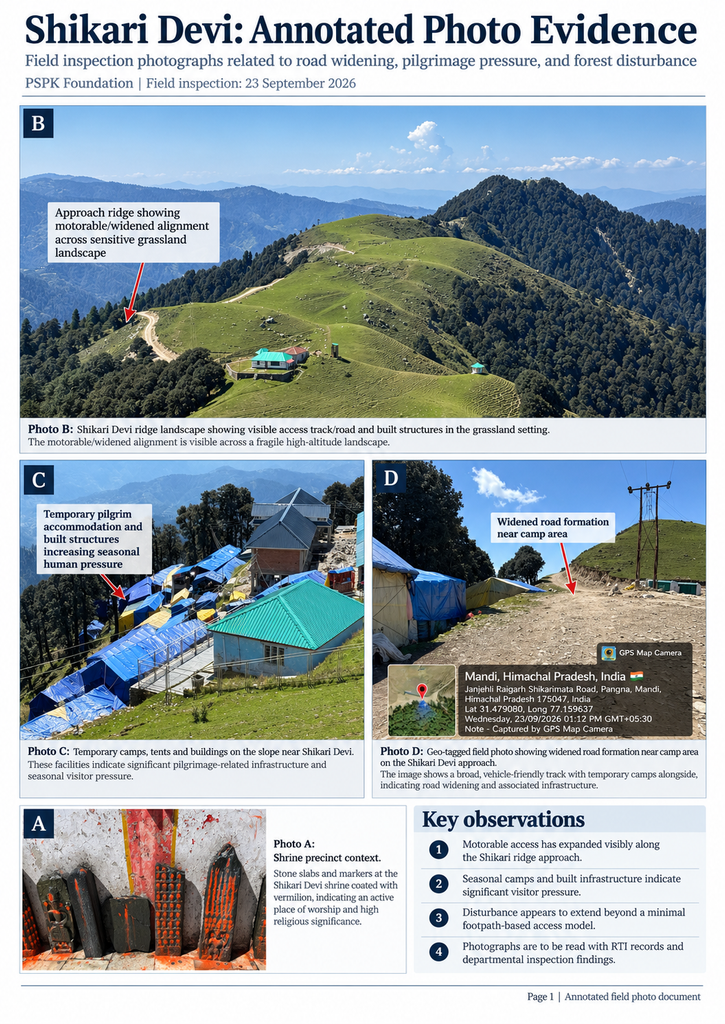
Shikari Devi annotated photo evidence, Page 1: Ridge landscape showing motorable access, temporary pilgrim accommodation, road formation near the camp area and the shrine precinct.
These observations raise questions about the scale of infrastructure development and the cumulative effects of increased visitor access within a sensitive mountain environment.
Forest Disturbance and Slope Cutting
Our field photographs also document disturbed forest slopes, exposed soil, rocky spoil and woody debris at several locations along the Shikari Devi approach.
Geo-tagged images show physical alterations to forested terrain, including an excavated or eroded slope section with loose rock and soil. Other photographs record rocky material and fallen or cut logs within forested areas.
The visible conditions suggest earthwork, spoil movement and slope disturbance that require comparison with sanctioned road construction plans and departmental records.
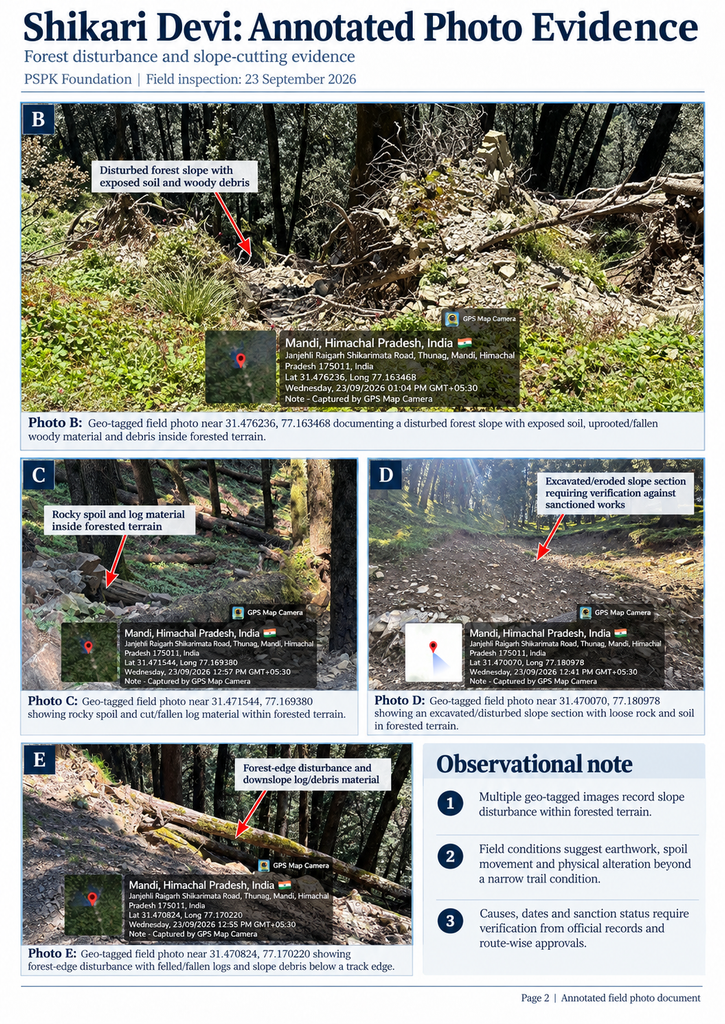
Shikari Devi annotated photo evidence, Page 2: Geo-tagged photographs documenting disturbed forest slopes, exposed soil, rocky spoil, woody material and an excavated or eroded slope section.
The photographs establish the physical condition of these locations at the time of inspection. However, the causes, dates and approval status of the observed works must be verified through official records and route wise examination.
Fallen Timber, Rocky Spoil and Debris
Additional photographs document fallen or cut log and trunk material along disturbed forest slopes, together with stones, rocky spoil and woody debris scattered across the forest floor.
The accumulation of this material indicates physical disturbance in parts of the Shikari Devi landscape. However, the origin of individual tree trunks, the timing of their fall and their possible relationship with road works remain matters requiring verification.
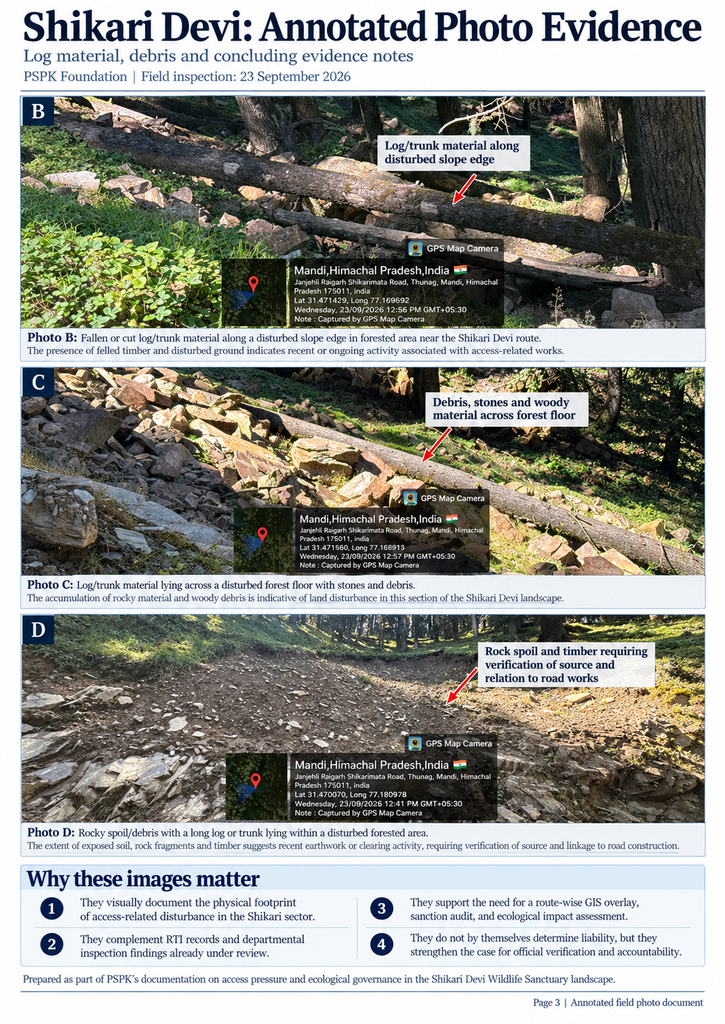
Shikari Devi annotated photo evidence, Page 3: Fallen log and trunk material, rocky spoil, debris and exposed ground within disturbed forested terrain.
Together, these geo-tagged photographs provide an identifiable field record that can be examined alongside historical satellite imagery, sanctioned road alignments, RTI records and departmental inspection findings.
Although photographs alone cannot establish responsibility or prove unauthorised tree felling, they strengthen the need for a detailed investigation into the extent, timing and causes of landscape disturbance.
Why These Findings Matter
Road widening in fragile Himalayan terrain can permanently affect slope stability, natural drainage, soil retention, wildlife movement and the ecological character of protected habitats.
Within a wildlife sanctuary, the consequences of construction activity can extend beyond the immediate road surface. Excavation, movement of rocky material, disturbance of forest slopes and increased human accessibility can place additional pressure on surrounding ecosystems.
The central question is not simply whether a road provides access for pilgrims or visitors. It is whether construction and subsequent expansion have complied with the statutory safeguards established to protect wildlife and forest ecosystems.
The Wildlife (Protection) Act, 1972, forest conservation legislation and applicable Eco-Sensitive Zone regulations establish legal obligations for activities affecting protected landscapes.
The Eco-Sensitive Zone notification for the area came into effect in January 2022. Consequently, works undertaken before that date must be examined against the laws and environmental protections applicable at the relevant time.
Proper assessment requires consideration of the applicable legal framework, the dates of construction, the permissions granted and the actual physical extent of the works.
The Need for Transparency and Accountability
We are calling upon the Government of Himachal Pradesh, the Forest Department, the Public Works Department and the concerned central authorities to publicly establish the following facts:
- Road alignment and extent: The precise length and alignment of road widening undertaken within the sanctuary and adjoining protected forests.
- Statutory clearances: Whether prior Forest Conservation Act and wildlife clearances existed for every relevant section and activity.
- Project expenditure: The expenditure incurred, administrative and technical sanctions granted, and the officers responsible for execution.
- Environmental disturbance: The extent of tree removal, excavation, slope disturbance and dumping of construction debris.
- Ecological assessment: Whether a cumulative ecological impact assessment and visitor carrying capacity assessment have been undertaken.
- Departmental action: What action followed the Wildlife Department’s inspection findings from May 2023.
- Restoration measures: What ecological restoration, access regulation and wildlife protection measures are now proposed.
Public clarification of these matters is essential for establishing whether the works complied with applicable legal requirements and for determining what further investigation or corrective measures may be necessary.
The Larger Question: Development or Ecological Protection?
The Shikari Devi investigation highlights a wider challenge facing the Himalayan region. Infrastructure development may provide immediate accessibility, but its cumulative ecological consequences can remain unmeasured for generations.
A fundamental question arises when motorable access and visitor infrastructure expand within a legally protected wildlife habitat: should a sanctuary progressively become a motorable tourism destination, or should wildlife and habitat protection remain its overriding purpose?
We believe the answer must be guided by ecological science, the rule of law and the constitutional responsibility to protect the natural environment.
Religious traditions deserve respect, while legitimate community access and emergency services must also be protected. However, these considerations cannot justify unrestricted commercial expansion into critical wildlife habitats.
Development decisions in sensitive mountain landscapes must account for environmental limitations and the long term protection of natural ecosystems.
Our Commitment to Ecological Responsibility
Not every mountain needs a road, and not every forest needs tourism infrastructure. A wildlife sanctuary must remain a sanctuary for wildlife.
We will continue pursuing documentary transparency, independent scientific assessment and institutional accountability concerning development activities affecting the Shikari Devi landscape.
Issues relating to sensitive Himalayan access routes are also before the Hon’ble High Court of Himachal Pradesh in ongoing environmental proceedings. Relevant documentary evidence is being organised for consideration through the Court appointed Amicus Curiae.
This investigation forms part of our continuing commitment to the Himalayan Environmental Charter and its principle of ecological responsibility.
Protecting Shikari Devi Wildlife Sanctuary requires a careful balance between legitimate human needs, statutory obligations and the long term conservation of Himalayan biodiversity. Transparent records, scientific assessment and responsible environmental governance remain essential to ensuring that development does not compromise the ecological purpose of protected wildlife habitats.
Editorial disclosure: Findings concerning clearance deficiencies are based on RTI supplied departmental inspection material and correspondence. The precise present status of all project wise approvals, the causes of individual tree falls and the liability of specific authorities remain matters for documentary verification and competent investigation.
Related Articles
More stories and updates worth exploring from our journey.