The Anatomy of Mountain Degradation

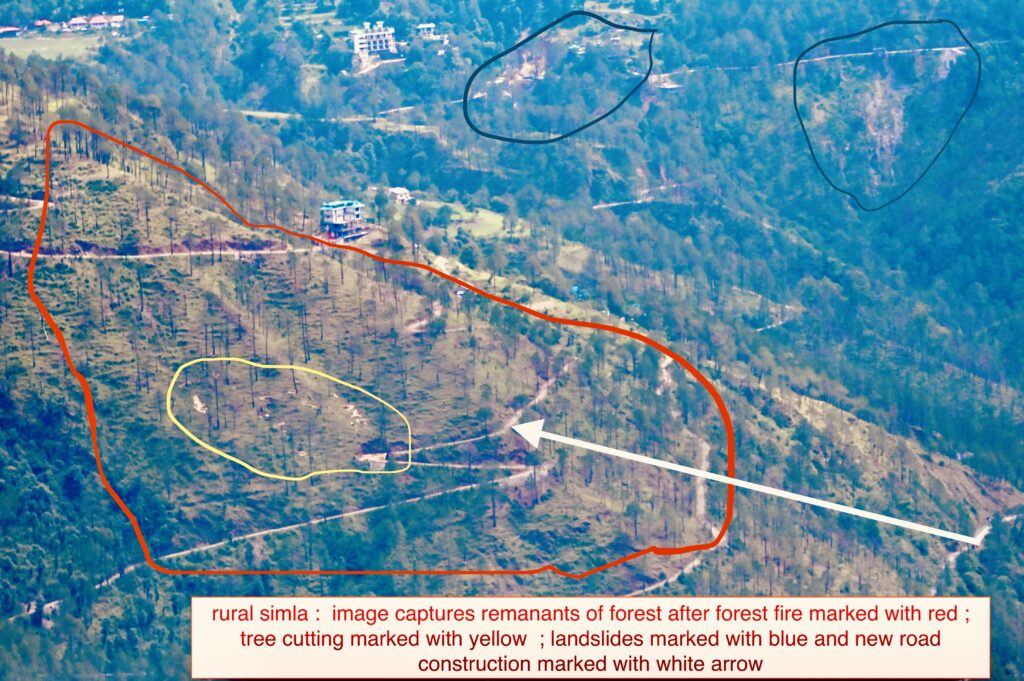
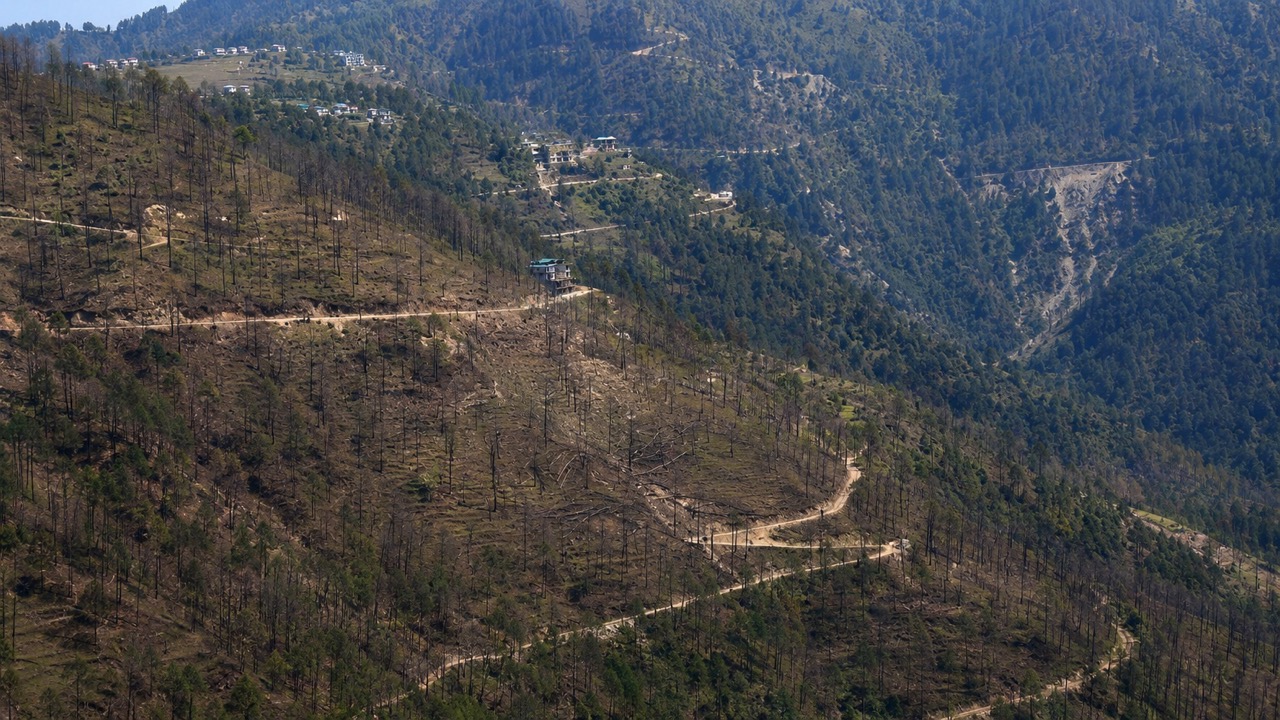
At first glance, the photograph appears to show an ordinary Himalayan hillside. A slope, a forest patch, a road cut and a few exposed scars on the mountain may seem like familiar features of hill landscapes. But when seen carefully, this is not an ordinary scene. It is a complete visual record of how mountain degradation unfolds.
Within one frame, the photograph captures a chain of damage: forest fire, tree loss, road cutting, slope disturbance and landslides. These are often treated as separate issues. In reality, they are closely connected. One weakens the mountain, the next deepens the damage, and the final result appears in the form of erosion, landslides, water stress and long-term ecological decline.
The red-marked zone shows the remains of a forest affected by fire. A forest fire is not limited to the flames that burn for a few hours or days. Its impact continues long after the smoke disappears. Burnt vegetation reduces ground cover. Exposed soil becomes more vulnerable to rain, wind and surface runoff. Tree roots that once helped hold the slope together begin to weaken. The forest floor, which normally absorbs moisture and slows the movement of water, loses much of its protective capacity.
A living forest is not only a collection of trees. It is a natural system that binds soil, stores moisture, supports biodiversity and regulates the movement of water across the slope. When fire damages this system, the mountain loses part of its natural defence.
Within this already damaged landscape, the yellow-marked patches indicate fresh tree felling. This makes the situation more serious. A fire-affected forest needs time, protection and natural regeneration. Instead, additional removal of trees further reduces the slope’s ability to recover.
Every tree removed from such a landscape means more than the loss of timber or greenery. It means fewer roots holding the soil. It means less shade for the forest floor. It means faster drying of the land. It means reduced protection against runoff during heavy rainfall. On steep Himalayan slopes, vegetation is not decorative. It is structural support.
This is why tree felling in a fragile or fire-damaged zone cannot be viewed casually. A slope that has already lost part of its ecological strength should not be further stripped of its remaining protection. When fire and felling occur together, they create a weakened landscape that becomes more exposed to future stress.
The white arrow in the photograph highlights a newly cut road. Roads are commonly presented as signs of development, access and connectivity. In mountain regions, roads are often necessary. But the way they are planned, cut and maintained determines whether they serve the landscape or damage it.
A road in the mountains is never just a line on a map. It is a cut into a living slope. It changes the way water moves. It removes soil and rock from the hillside. It disturbs natural drainage channels. It can leave loose material exposed to rainfall. If road construction is not supported by proper slope stabilisation, drainage management and ecological safeguards, it can become a starting point for further degradation.
This does not mean that every road is destructive. It means that every road in a fragile mountain landscape carries responsibility. The higher the slope, the weaker the geology, the thinner the vegetation and the heavier the rainfall, the more careful the intervention must be. In such areas, poor road cutting can turn a hillside into a future landslide zone.
The consequences are already visible in the blue-marked areas. These landslide scars are not isolated accidents. They are the visible response of a mountain under cumulative stress. A slope weakened by fire, stripped of trees and disturbed by excavation becomes less stable. When rainfall arrives, water enters exposed soil and loose material. The slope begins to fail.
A landslide is often described as a natural disaster. But many landslides are not entirely natural. They are the final expression of a long process of disturbance. Fire weakens the ecosystem. Tree loss reduces root support. Road cutting changes slope structure and drainage. Rainfall then exposes the damage that was already building silently.
This is the central lesson of the photograph: the four visible problems are not separate. They are part of one connected chain.
Forest fire leads to tree loss.
Tree loss weakens soil and slope stability.
Road expansion disturbs the hillside further.
Disturbed slopes become more vulnerable to landslides.
Landslides then accelerate ecological degradation.
Once this chain begins, the damage does not remain limited to the hillside. Soil erosion affects streams and water channels. Springs may weaken when catchments are disturbed. Agricultural land below may receive debris and silt. Roads may collapse. Settlements may become more vulnerable. What begins as damage on a slope can travel into the valleys below.
The Himalaya is not just a scenic mountain range. It is a living infrastructure. It holds forests, watersheds, springs, rivers, biodiversity and rural livelihoods. It supports communities living in the mountains and millions of people downstream. When forests are damaged and slopes are destabilised, the consequences move through water systems, farms, roads, villages and towns.
The tragedy is that each intervention is usually viewed in isolation. A forest fire is treated as a seasonal event. Tree felling is treated as a local requirement. Road cutting is treated as development. Landslides are treated as natural disasters. Rarely are they understood as parts of the same ecological story.
This fragmented view is dangerous. It allows damage to accumulate without accountability. One department may look at fire. Another may look at roads. Another may look at disaster response. But the mountain experiences all of it together. The slope does not separate fire, felling, excavation and rain into different files. It responds to the combined pressure.
That is why this photograph matters. It does not simply show a damaged hill. It shows how degradation is built step by step, often in plain sight. The warning is visible before the disaster becomes unavoidable.
The question before us is difficult but necessary:
Are we witnessing development in the Himalaya, or are we documenting the gradual dismantling of the natural systems that make mountain life possible?
Development cannot be measured only by the number of roads built, hotels constructed or land parcels converted. In the Himalaya, real development must also be measured by whether forests survive, slopes remain stable, water sources continue to flow and communities remain safe.
A road that triggers repeated landslides is not progress. A hillside stripped of trees is not development. A forest that burns every summer and receives no serious protection is not a managed landscape. A mountain that loses its natural strength will eventually send the cost of that damage back to people.
The future of the Himalaya depends on whether development is planned with ecological limits in mind. Forests must be treated as protective infrastructure. Road construction must respect slope stability and drainage. Fire-affected areas must be allowed to regenerate. Tree felling in fragile zones must be questioned with seriousness. Landslides must be studied not only as disasters, but as symptoms of deeper land-use failure.
This hillside is not merely a landscape.
It is a warning.
The mountain records every intervention. A fire leaves its mark. An axe leaves its mark. A road cut leaves its mark. Rainfall then reads those marks and turns them into erosion, landslides and loss.
Nature keeps the accounts even when governments, contractors and communities choose not to.
If such warnings continue to be ignored, today’s scars on the mountain will become tomorrow’s disasters in the valleys below. The Himalaya does not collapse in a single moment. It weakens slowly, through repeated disturbance, until one day the damage becomes impossible to deny.
Related Articles
More stories and updates worth exploring from our journey.